Why Brand Symbols Matter in Digital Marketing
Why Brand Symbols Matter in Digital Marketing
Attention: That's what we're all competing for.
Potential customers move quickly between Google, websites, social media, emails, advertisements and countless other digital touchpoints. They may only see your business for a few seconds before moving on.
That means your brand doesn't just need to be seen.
It needs to be recognised.
One of the most powerful ways to build that recognition is through a strong visual identity and a distinctive brand symbol.
Think about the brands you recognise without needing to read their names. A colour, shape, symbol or particular combination of visual elements can be enough to tell you immediately which brand you're looking at.
That recognition doesn't happen by accident.
It is built through clarity, simplicity and consistency.
At That's Business Today, we describe it even more simply:
Clear. Concise. Consistent.
And those three principles should apply to your branding just as much as they apply to your marketing.
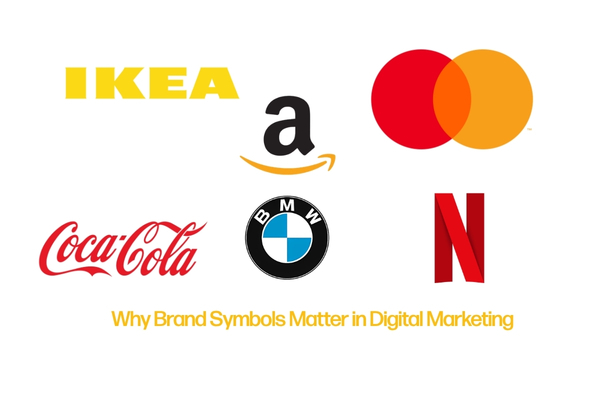
What Is a Brand Symbol?
A brand symbol is a visual element that helps identify and represent a business. It can form part of a logo or work independently as a recognisable visual cue associated with the brand.
Over time, consistent use helps people connect that symbol with the business, its products or services and their previous experiences with the brand.
Importantly, a brand symbol doesn't always have to explain exactly what a business does.
Its job is to help people recognise who the business is.
What Is the Difference Between a Logo, Brand Symbol and Visual Identity?
These terms are often used interchangeably, but they aren't quite the same thing.
A logo is the primary visual identifier used to represent a business. It may include the business name, typography, a symbol or a combination of these elements.
A brand symbol is a recognisable visual element that may be able to stand independently of the full logo.
A visual identity is the larger system surrounding the brand. It can include the logo, symbols, colours, typography, imagery, graphic elements and rules governing how all of these are used.
Together, these elements create a visual language for your business.
The objective is not simply to make your marketing look attractive. It is to make your business recognisable.
Why Are Symbols Important in Branding?
Symbols act as visual shortcuts.
People can process a familiar visual cue quickly without needing to stop and read an entire message.
In a digital environment, that matters.
Your potential customer might encounter your business through a Google search today, see an Instagram post next week and visit your website a month later.
A consistent visual identity helps connect those separate interactions.
The customer begins to think:
"I've seen this business before."
That familiarity is an important part of building brand recognition.
How Do Brand Symbols Improve Brand Recognition?
Recognition develops when people repeatedly encounter the same visual cues and begin associating them with a particular business.
That's why changing colours, logos, fonts and design styles from one marketing channel to another can work against you.
Instead of reinforcing one identity, you are continually introducing different versions of your business.
A strong brand symbol gives your marketing an anchor.
Whether someone finds you through your website, Google Business Profile, Facebook, Instagram, LinkedIn, YouTube, email marketing or digital advertising, there should be something that tells them:
This is the same business.
Clarity Creates Recognition
Good branding shouldn't make people work hard to understand it.
The strongest visual identities tend to have clarity.
When your symbol is easy to identify, it reduces unnecessary visual noise and makes it easier for your audience to recognise your business.
That doesn't mean every logo needs to be extremely minimalist.
It means every element should have a purpose.
Ask yourself:
Can someone identify our brand quickly?
If the answer requires a lengthy explanation of what every colour, line, shape and icon represents, the design may be trying to communicate too much.
Why Does Simplicity Make a Brand More Memorable?
People rarely study branding.
They glance at it.
Particularly online.
Someone scrolling through Instagram, looking through Google results or moving between websites isn't necessarily concentrating on your logo.
Your branding therefore needs to work quickly.
A concise visual identity removes unnecessary elements and focuses attention on the characteristics you want people to remember.
This also makes your branding easier to reproduce across different formats — from a large website banner to a tiny social media profile image.
The goal isn't simplicity for simplicity's sake.
The goal is recognition.
Why Is Brand Consistency Important?
Consistency reinforces recognition.
Every time someone encounters the same visual identity, you have another opportunity to strengthen the connection between that identity and your business.
That is why branding should not be treated as something that only sits at the top of your website.
It should form part of your entire marketing ecosystem.
Your website shouldn't look like one company while your social media looks like another.
Your advertisements shouldn't introduce a completely different visual style.
Your email marketing shouldn't feel disconnected from everything else.
Your customer may interact with all of these touchpoints before deciding to contact or buy from you.
Each one should reinforce the same brand.
The That's Business Today Rule: Clear. Concise. Consistent.
At That's Business Today, three words continually come back into our approach to marketing:
Clear. Concise. Consistent.
They apply particularly well to branding.
Clear
Can people quickly understand who you are?
Your visual identity and messaging shouldn't leave your audience trying to work out what business they're looking at or what you actually do.
Concise
Have you removed what isn't necessary?
More elements don't necessarily create a stronger brand. Often, they simply create more noise.
Your visual identity should communicate without overwhelming.
Consistent
Does your business look and feel like the same brand wherever people encounter it?
Your website, Google presence, social media, advertising, video, email marketing and offline materials should reinforce rather than compete with each other.
Clear gets you understood.
Concise gets you remembered.
Consistent gets you recognised.

Where Should Your Brand Symbol Appear Online?
Your brand symbol should become a consistent visual thread throughout your digital presence.
That includes your:
Website and favicon
Google Business Profile
Facebook and Instagram profiles
LinkedIn company page
YouTube channel
Digital advertising
Email marketing
Videos
Downloadable documents and guides
Presentations and proposals
Online forms and landing pages
The exact format may need to change according to the platform.
A horizontal logo that works beautifully across the top of your website, for example, may become unreadable when squeezed into a small circular social media profile image.
That's where a strong brand symbol becomes particularly useful.
It gives you a simplified visual identifier while maintaining the connection to the broader brand.
Can Consistent Branding Build Trust?
Consistency can contribute to trust because it creates familiarity and makes a business appear more coherent and established.
Imagine clicking an advertisement and arriving on a website that looks completely different.
The colours have changed. The logo looks different. The language is different.
You may start wondering whether you've landed on the right website.
That's unnecessary friction.
Now imagine seeing an advertisement, clicking through and immediately recognising the same visual identity, messaging and business.
There is continuity between the two experiences.
Consistency doesn't create trust by itself — a business still needs to deliver on its promises — but it helps create a professional and familiar environment in which trust can develop.
Your Brand Is More Than Your Logo
One of the biggest mistakes businesses make is believing that branding begins and ends with a logo.
It doesn't.
Your brand is the broader experience and perception people develop of your business.
Your visual identity helps represent that experience.
Your messaging shapes it.
Your marketing communicates it.
Your customer experience ultimately proves it.
That's why branding and digital marketing shouldn't operate independently.
Every marketing touchpoint contributes something to how people perceive and remember your business.
How Do You Build a Recognisable Digital Brand?
Start by looking at your business from the customer's perspective rather than your own.
Search for your business on Google.
Visit your website.
Open your Facebook, Instagram and LinkedIn profiles.
Look at your latest advertisement.
Open one of your marketing emails.
Now put them side by side.
Do they look like they belong to the same business?
Look at the logo, colours, fonts, imagery, tone of voice, messaging and calls to action.
There will naturally be differences between platforms and campaigns, but the underlying identity should remain recognisable.
If your branding continually changes depending on who's creating the marketing, which platform you're using or what campaign you're running, it becomes harder to build recognition.
Frequently Asked Questions About Brand Symbols
What makes a good brand symbol?
A good brand symbol should be distinctive, recognisable and adaptable. It needs to work across different sizes and digital environments while remaining connected to the overall identity of the business.
Does every business need a separate brand symbol?
Not necessarily. Some businesses rely primarily on a wordmark or business name. However, having a visual element that can be recognised independently can be particularly useful across social media, favicons, apps, video and other digital environments where space is limited.
Is a brand symbol the same as a logo?
Not always. A logo is the main visual identifier for a business and may include the company name and a symbol. A brand symbol can be one element of that logo that becomes recognisable independently.
Should my branding be exactly the same on every platform?
Your core visual identity should remain consistent, but the execution may need to adapt to the platform. A website banner, Instagram profile image, LinkedIn advertisement and email signature have very different dimensions. Adapt the format without losing the identity.
Can I change my brand symbol?
Yes. Businesses and brands evolve. However, significant changes should have a clear purpose and be implemented consistently so that existing brand recognition isn't unnecessarily lost.
Building a Brand People Remember
Your brand shouldn't have to introduce itself from scratch every time someone sees it.
Strong digital brands build familiarity through repetition.
The same visual cues.
The same personality.
The same underlying message.
The customer might first discover you through Google, encounter you again on social media, read one of your articles and finally return to your website when they're ready to act.
Each interaction should strengthen their recognition of your business rather than start the process again.
That's why we believe effective digital branding comes back to three things:
Clear. Concise. Consistent.
Get those right and your marketing doesn't simply become more attractive.
Your business becomes easier to understand, easier to recognise and easier to remember.
Is Your Digital Brand Consistent?
Take a look at your website, Google presence, social media, advertising and email marketing.
Does it all look, sound and feel like the same business?
If not, it may be time to look beyond individual marketing channels and develop a more consistent digital strategy.
That's Business Today helps businesses bring their branding, website, content, search, social media, advertising and digital strategy together — so every touchpoint works towards the same goal.
Start today for tomorrow's success.